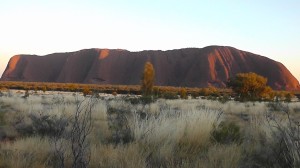
Uluru is one of those iconic Australian landmarks that most children grow up knowing about and having seen pictures of. And it’s one of those places I imagine many Australians would like to see for themselves at some point in their lives. This has been the case for me. Having seen many pictures of it, it was amazing to think that I was there now, actually seeing it for myself.
Part of the whole learning experience was seeing how the whole ‘visiting Uluru’ thing is managed now. I really wasn’t sure what to expect, until a couple of days before coming here when I did a bit more specific reading on it – even then it was all still a bit unknown.
For example, seeing Uluru at sunrise is a whole exercise in logistics. There is a specific viewing area for sunrise and a different one for sunset. And apparently there has been a bit of contention about where these have been chosen to be located. Anyway, so you find out the time for sunrise on the day you want to see it and you have to allow half an hour drive from the campground area to drive into the NP and to the sunrise viewing area. So I got up at 6am and nudged Lauren and Sam to see if they wanted to come – they both did. We had a quick bite to eat and a cuppa and left the campground at 6.30am. The entrance to the NP was 5 mins along the road and here we had to buy passes to the NP ($25 per adult, children 16 and under were free – yay). We drove past one side of Uluru and marvelled at the amazing structure that it is. The sunrise viewing area was around the other side. We got there by 7am and it was already packed with people. Sunrise was 7.25 am today. We joined the throng and took some photos. Then about 7.30 we headed bak to the caravan where Michael, Hannah and Beth were finishing breakfast.
We got ourselves ready for the day and drove back in towards Uluru, this time taking the road towards the Mala walk and where the Uluru climb starts. We had looked at the different options for doing walks around the rock. Many people do the walk around the whole base, but being 7.5km, it was not something we thought we would try to do with the young girls. It is obvious that the rangers discourage the climbing of Uluru because there is absolutely no reference to where the climbing area of the rock is, either on the official map or the road signs in the park. We had to guess where it was. As far as the whole climbing thing was concerned, that was an education in itself for our family. Sam absolutely loves rock climbing and so was keen to do the climb. We had been talking to him (and all the kids) about the issues around it and why the aboriginal people and rangers discourage it. He took all this on board and read up on it on some websites. In the end he still wanted to do the climb, but with a respectful attitude about it. So Michael was prepared to do the climb with Sam and Lauren. However, as it turned out, the climb was closed due to strong winds at the summit. Sam was disappointed, however hopeful that the climb would open either that afternoon or the next day.
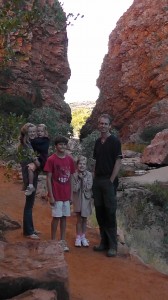
Our alternative plan was to do the Mala walk (which I had planned to do with the girls anyway). This was a short walk to a gorge area at the base of the rock. We found out that there is a free ranger-guided tour on the Mala walk at 10am each day. It was 9.15 at the time. So we decided we would go back to the cultural centre for a little while, until the tour start time. We did this – it was a fairly quick look. Then we were back at the start of the Mala walk. We met our ranger guide -Tim. He indicated it would be a 2 hr tour with lots of information about the cultural aspects of Uluru, as well as the geological aspects. We decided we would start with the group, and see how the kids were holding out as to how long we stayed with it. It turned out we stayed for the whole 2 hrs and learnt quite a lot of interesting information. Lauren and Sam listened in to all of it, and Hannah and Beth listened to some and played in the dirt quietly for a lot of it – this was OK. We learnt about how the more lush vegetation was close in to the base of the rock because when it rained the rock had sections of it which became like waterfalls and directed water to certain areas around the base. The aboriginals would come into the area and gather food etc for a period and then move on. They didn’t tend to live permanently at the rock. We learnt some more about the bush tucker and how they made their weapons and eating implements from the bark of trees. We saw some aboriginal art sites and our guide described some of the background to aboriginal art and how it usually tells a story. He did this by drawing with a stick in the dirt and it was very interesting the way he described the whole thing. He had all the kids captivated. For the next few days Hannah and Bethany were always drawing pictures and stories in the dirt. Next we learnt about some of the geology of the rock – that it is actually feldspar – a metaphorphosised type of sandstone. Pure feldspar is actually a greyish colour, but the rock looks red because the red dust from the surrounding plains blows onto it and it now has a thick layer of this red (rust) dirt on it. Rather than being smooth, the surface of the rock is actually like shingles on a roof, facing upwards. This is due to the effect of the water running down the rock and causing ‘blisters’ that lift off, just like the blistering that occurs on a rusting car. Our guide described it like a cheese grater. And he said it does damage like a cheese grater when people fall doing the climb and slide down. We learnt a little bit about some of the mammals in the area too. We finished the tour at the waterhole of Mala gorge. We then all walked back to the car.
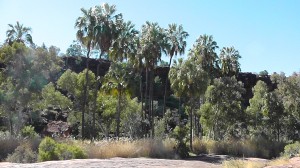
We had decided to also drive out to Kata Tjuta (the Olgas) today and do a walk out there. Kata Tjuta is about 30-40km further west of Uluru. It is a series of domes, also composed of Feldspar. They have similar geology to Uluru, but formed into smaller domes rather than one big dome. They also have the cheese grater effect on their surface. It was a half hour drive to Kata Tjuta, although it took a bit longer because we stopped at the viewing area which was on top of some dunes. The walk we had wanted to do was called the Valley of the Winds. The first 1km was a return walk to a lookout area, and from there it was a loop walk within the domes for another ?km. We would have liked to do the whole walk, but we knew Hannah and Bethany would not be up to it. So we just walked to the first lookout area. It was an amazing feature in itself. It was about 2.30 by now and, since we were going to have an early dinner to go and see Uluru at sunset, we decided to head back to the van.
We got back around 3.30 and so the kids had some down time. Lauren usually likes to read, watch a movie or check emails etc. Sam usually likes to keep doing active things – ride his bike, kick a ball, go to the playground or find a tree to climb. Hannah and Beth love to just be together playing a ‘let’s pretend’ game – there is always a story involved. Sometimes it is at the playground or pool or sometimes just around the van somewhere. If they are getting tired then being together is not always the best option – sometimes we have to separate them and give them different activities to do, sometimes at different ends of the caravan. This time Michael took them to the pool for a while and I got some things ready for dinner. We were having a BBQ for dinner and trying some kangaroo meat with the sausages.
We were having dinner by just after 5pm, planning to hop in the car at 5.30 to drive to the sunset viewing area. I was feeling rather tired by now after the long day and decided I might opt out of going and just see the photos the others took. So I stayed back and did the washing up and then some quiet time.
Then once the others got back, they showed me the photos and then it was time for showers and off to bed. It had been a long day but a good day.